
Plants
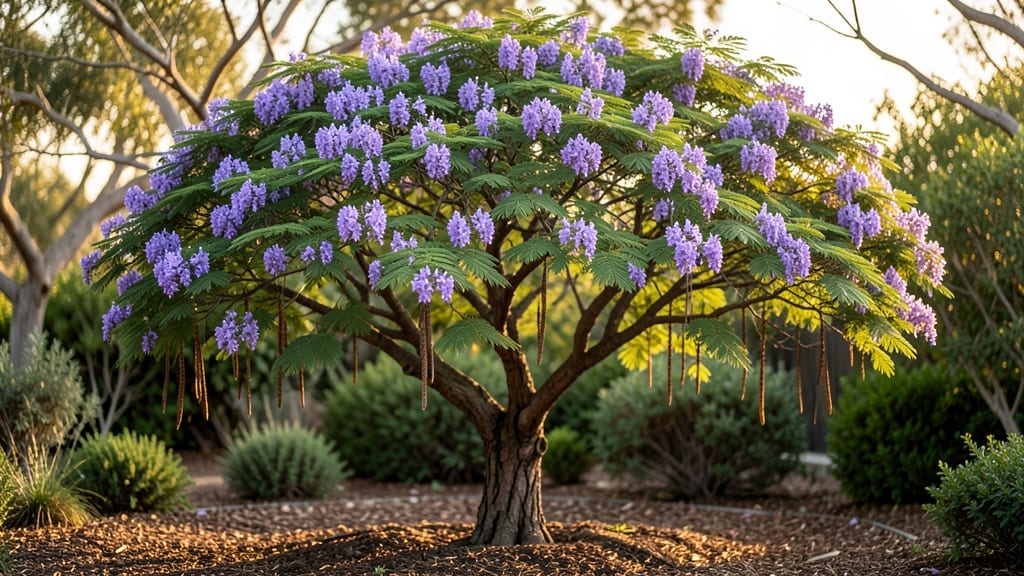
A jacaranda tree looks like a tropical dream with its dramatic lavender-blue flower clusters that spill down like waterfalls, paired with delicate fern-like leaves made of 5-9 leaflets. The tree's smooth gray bark develops subtle grooves as it matures, while its broad, rounded canopy stretches 30-40 feet tall.
A jacaranda's most iconic feature is its springtime flower display, which can blanket the ground in petals when mature trees bloom. 🌸 The flowers grow in dense, drooping clusters that range from soft lilac to deep violet, depending on the variety and location.
While the flowers steal the show, the tree's compound leaves—arranged in pairs along the stems—add year-round interest with their intricate, almost lace-like structure. Younger trees have smoother bark, while older specimens develop those distinctive shallow grooves that give mature jacarandas their textured character.
What makes identification easy is how these elements work together: the vibrant blue-purple blooms in spring, the airy foliage that stays green through summer, and the upright growth habit that sets it apart from flatter-growing trees.
Even in winter when the tree is dormant, the gray bark pattern remains a dead giveaway.
💡 In This Article
- Identifying Jacaranda Tree Flowers, Leaves, and Bark
- How to Spot a Jacaranda Tree in Different Seasons
Identifying jacaranda tree flowers, leaves, and bark
The jacaranda's flower clusters are its signature feature, growing in dense, drooping racemes that can reach 8-12 inches long. Each cluster contains 50-100 individual flowers with five fused petals forming a trumpet shape.
The color spectrum ranges from pale lavender to deep indigo, with some tropical varieties even producing white-edged petals. What's fascinating is how the flowers open sequentially along the raceme, creating a stunning gradient effect from top to bottom.
The compound leaves are where the tree's botanical elegance shines. Each leaf consists of 5-9 oval leaflets arranged in pairs along a central stem, giving them that distinctive fern-like appearance. The leaflets measure about 1-3 inches long and have smooth edges with visible parallel venation that runs lengthwise.
Young leaves emerge with a slight reddish tint before maturing to a rich green, and they grow on alternate branches rather than opposite pairs.
The bark's transformation tells the tree's age story. Young jacarandas have smooth, silvery-gray bark with a slightly waxy texture, while mature specimens develop shallow, diamond-shaped fissures that create a subtle textured pattern.
This bark is naturally resistant to pests, which is why jacarandas thrive in urban environments. The bark's color darkens slightly with age, shifting from light gray to a more muted charcoal tone.
What sets jacarandas apart visually is their growth habit. The tree develops a rounded, vase-shaped canopy with multiple trunks emerging from the base, creating that iconic "umbrella" shape. The branches grow upward at 45-60 degree angles, allowing the flower clusters to spill dramatically downward.
This growth pattern maximizes sunlight exposure for the leaves while showcasing the flowers.
Regional variations create fascinating differences. Jacarandas in Australia's subtropical zones often produce darker purple blooms, while those in California's Mediterranean climate tend toward softer lavender hues. The leaf size also varies slightly—tropical varieties have larger leaflets, while arid-region trees develop smaller, more drought-resistant foliage.
One unexpected detail is how the flowers release a faint, sweet fragrance in the early morning, particularly on warm days. This subtle scent, combined with the visual drama, makes jacarandas a favorite for urban landscaping.
The tree's fast growth rate of 2-3 feet per year means it reaches its mature height of 30-40 feet within 10-15 years, making it a quick investment for dramatic landscaping.