
Pruning
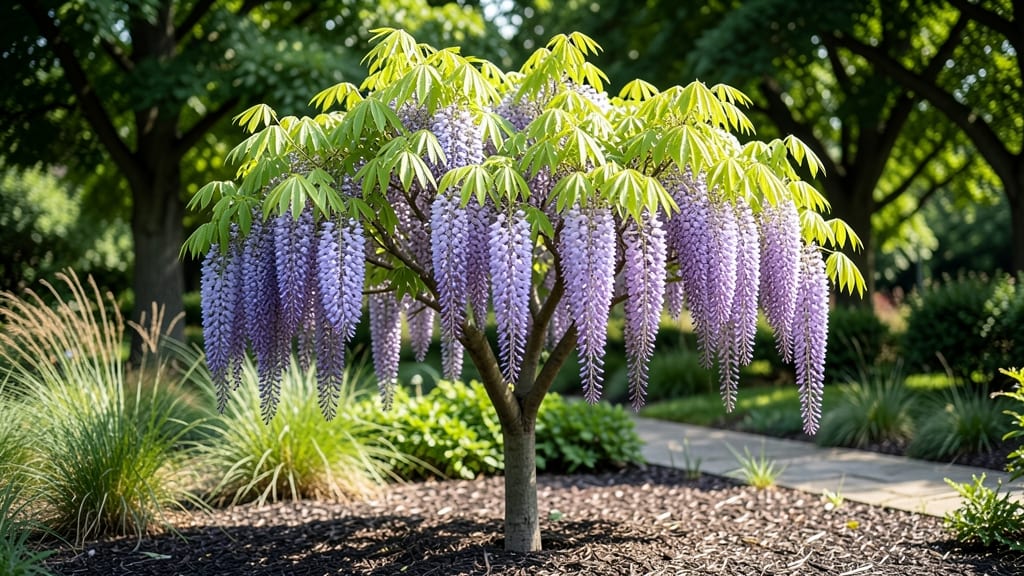
Transforming Amethyst Falls Wisteria into a stunning tree form starts with a single, bold decision: one main trunk. 🌿 I learned this after years of tangled vines—now my wisteria climbs like a graceful sentinel, its cascading blooms reaching higher than my second-story deck.
The secret lies in early pruning: shape the trunk in its first year by removing all side shoots, leaving just the strongest central leader. Use sharp pruners to cut at a 45-degree angle just above a bud, and repeat every spring to maintain that single-stem silhouette.
Most gardeners stop here, but the real magic happens in late winter, when you fine-tune the structure before new growth begins. By summer, you’ll see the payoff—long, arching branches heavy with fragrant violet blooms, all supported by that single, sturdy trunk.
The plant stays disease-resistant and blooms more prolifically than tangled vines ever did, with minimal deadheading needed. Works for both sunny walls and sturdy trellises—just ensure the support can handle 20+ pounds of blooms when in peak season. Here’s how to keep it thriving year after year.
📚 In This Guide
- What you need
- Instructions
- Tips and common mistakes
- Wrapping up and next steps
What you need
- ● Pruning shears – Bypass pruners (sharp, 6-8" blades) for clean cuts on branches up to ½" thick.
- ● Loppers – Bypass or anvil type (8-10" blades) for branches ½" to 1½" thick.
- ● Pruning saw – Curved-tooth or folding saw for thicker branches (1½"+).
- ● Rubbing alcohol (70% isopropyl) – 8 oz bottle for sterilizing tools between cuts.
- ○ Pruning sealant – Optional but recommended for large cuts (1+") to prevent disease.
- ● Garden gloves – Heavy-duty, cut-resistant (e.g., Mechanix or leather) to protect hands.
- ● Ladder or extension pole – Sturdy, 12-16 ft tall (with non-slip feet) for high branches.
- ● Tarp or drop cloth – Medium-sized to catch debris.
- ● Twine or zip ties – For temporarily securing branches during shaping.
- ● Timing – Prune in late winter or early spring (before buds swell) or right after flowering (summer).
- ● Weather check – Choose a dry, calm day (no rain forecast for 24 hours).
- ● Safety first – Wear eye protection (goggles) and avoid pruning near power lines.
- ● Healthy plant – Ensure your wisteria is disease-free (no powdery mildew or cankers).
- ● Plant growth regulator – e.g., Apogee (diluted spray) to reduce stress post-pruning.
- ● Disposable pruning bags – For easy cleanup of clippings.
- ● Pole saw – If your wisteria has very thick, high branches (12"+).
- ● Camera or sketchbook – To document your pruning plan before making cuts!
Step-by-Step pruning guide for Amethyst Falls wisteria tree form
Transform your wisteria into a stunning vertical masterpiece with these precision pruning techniques.
✂️ Step 1: Prune for Structure in Late Winter
Timing is everything with wisteria—wait until late winter when the plant is fully dormant but before new growth begins. The Amethyst Falls variety thrives when you establish a strong central leader early. Start by removing any competing vertical stems that might vie for dominance, keeping only one primary trunk as your main leader.
Use clean, sharp pruners to make cuts just above a bud that faces outward on the trunk. This encourages upward growth while preventing a dense, tangled canopy. I always make my cuts at a 45-degree angle about ¼ inch above the bud—this prevents water from pooling and rotting the wound. Avoid cutting into old wood; new growth emerges from the buds closest to the trunk.
🌿 Step 2: Thin Out Crowded Branches in Early Spring
Once new shoots appear in early spring (around March in most climates), focus on thinning rather than cutting back. The goal is to create an airy, open structure that lets sunlight reach the center of the plant. Remove any branches growing inward or crossing over others—these compete for light and nutrients, weakening the overall form.
Look for shoots growing at a 45-degree angle or wider from the trunk; these are your future flowering branches. Leave 3-5 well-spaced branches along the main trunk, spacing them 12-18 inches apart. If a branch is too long, cut it back to a strong outward-facing bud to encourage bushier growth. Never remove more than one-third of the plant’s foliage in a single pruning session—this stresses the wisteria and reduces blooms.
☀️ Step 3: Encourage Flowering Branches Mid-Summer
After the first flush of blooms in late spring, shift your focus to promoting next year’s flowers. Wisteria blooms on old wood, so the branches you nurture now will carry the heaviest clusters next season. In mid-summer (July-August), inspect the current year’s growth and identify last year’s wood—it’s thicker and often has small buds forming along its length.
Trim back any overly vigorous new growth that’s shading these older branches, cutting to an outward-facing bud. For the Amethyst Falls variety, which produces lighter purple blooms, prioritize branches with strong, healthy leaves—these indicate vigorous growth capable of supporting abundant flowers. Avoid heavy pruning now; instead, lightly pinch back any shoots that exceed 12 inches to encourage branching. This is the time to shape the tree form, so step back occasionally to visualize the balanced, pyramid-like silhouette you’re creating.
⏰ Step 4: Final Light Pruning After Blooming
Once the Amethyst Falls wisteria finishes blooming (usually late May to early June), give it a final light pruning to tidy up and prepare for dormancy. Remove any dead, diseased, or weak branches first—these are easy to spot as they lack leaves or have brown, shriveled wood. Then, trim back overly long branches that detract from the tree form, cutting to a bud that improves the plant’s balance.
This is also the time to thin out any dense clusters of leaves that might block airflow, reducing the risk of fungal diseases. For the Amethyst Falls variety, which can produce long, graceful vines, resist the urge to cut back too aggressively. The goal is to maintain the vertical structure while encouraging next year’s blooms. After pruning, give the plant a deep watering to help it recover before summer heat sets in. Mulch around the base with 2-3 inches of organic mulch to retain moisture and regulate soil temperature.
Tips & tricks for perfect Amethyst Falls wisteria pruning
Mastering the art of pruning your Amethyst Falls wisteria transforms it from a tangled mess into a breathtaking vertical masterpiece. Here's what I've learned from years of shaping these stunning climbers.
Timing is Everything: Late winter pruning (Step 1) is your golden opportunity to establish that perfect central leader. I can't stress enough how crucial this is—waiting until buds begin to swell means you'll be cutting into new growth instead of dormant wood. The Amethyst Falls variety responds beautifully to this early intervention, developing that elegant pyramid shape we all dream of. Mark your calendar for the last week of winter when temperatures consistently stay above freezing but before those first green shoots appear.
The 45-Degree Rule: When making your cuts in Step 1, that 45-degree angle isn't just aesthetic—it's functional. The sloped cut prevents water from pooling at the wound site, which dramatically reduces the risk of fungal infections. I've seen too many wisteria plants develop cankers from improper cuts. Pro tip: Use a clean, sharp pruner and make your cut just above the outward-facing bud. The angle should be about ¼ inch above—this gives you that perfect balance between encouraging new growth while maintaining structural integrity.
Visualizing Your Pyramid: In Step 3, when you're shaping those flowering branches in mid-summer, step back frequently to visualize your pyramid. The Amethyst Falls' lighter purple blooms will look stunning when they cascade down in perfect symmetry. I like to imagine drawing an upside-down triangle from the top of my wisteria—any branches that fall outside this invisible guide get a gentle trim. For the Amethyst Falls variety specifically, prioritize branches with the strongest leaf growth along the outer edges of this triangle, as these will support the heaviest flower clusters next season.
Spring Thinning Strategy: During your early spring pruning (Step 2), think of yourself as a gardening sculptor rather than a brute-force cutter. The goal is to create an airy structure that allows sunlight to penetrate to the center. I've found that removing just 10-15% of the foliage in this session—focusing on inward-growing branches—makes all the difference. This approach maintains the plant's vigor while preventing that dense, impenetrable canopy that blocks light and air circulation. Remember, you're not trying to miniaturize your wisteria; you're creating an open framework that will support abundant blooms.
Pro Tips for Amethyst Falls Wisteria Tree Form
- Mastering the art of pruning your Amethyst Falls wisteria transforms it from a tangled mess into a breathtaking verti...
- Timing is Everything: Late winter pruning (Step 1) is your golden opportunity to establish that perfect central leade...
- The 45-Degree Rule: When making your cuts in Step 1, that 45-degree angle isn't just aesthetic—it's functional. The s...
Frequently asked questions
When is the best time to prune my Amethyst Falls Wisteria?
The ideal time to prune is late winter or early spring, just before new growth begins (typically February–March in most climates). This encourages strong, healthy blooms for the next season. Avoid pruning in fall or during active growth—it can stress the plant and reduce flowering. Pro tip: If you must prune after blooming, do so lightly to avoid cutting off next year’s flower buds.
How much can I trim back my Wisteria without harming it?
You can safely remove up to 30–50% of the previous year’s growth during late winter pruning. Focus on thinning out crowded stems and dead/dying wood first. For the Amethyst Falls Tree Form, avoid over-pruning the central trunk—this maintains its iconic shape. Heavy pruning (beyond 50%) can weaken the plant and delay blooming. Think of it like sculpting: gradual adjustments yield the best results!
Why isn’t my Wisteria blooming as much as it should?
Lack of blooms often stems from over-pruning in spring (when flower buds form) or poor sunlight. Ensure your Amethyst Falls gets 6+ hours of direct sun daily. Also, wisterias need mature wood (2–3 years old) to bloom—be patient! If blooms are sparse, check for nutrient deficiencies (add a balanced fertilizer in early spring) or pests like aphids, which can sap energy.
Can I shape my Wisteria into the Tree Form if it’s already grown as a vine?
Start by selecting the strongest central stem to serve as your trunk. Prune side branches back to 2–3 buds from the main stem, then train remaining branches to form a natural, balanced canopy. Use soft ties or pruning clips to guide growth. It may take 2–3 years to refine the shape, but consistency is key. Patience pays off with a stunning, architectural focal point!
What should I do if my Wisteria leaves are yellowing or dropping?
Yellowing leaves often signal overwatering, underwatering, or root issues. Check soil moisture—wisterias prefer well-draining soil and hate soggy roots. If roots are rotting, trim affected areas and repot if potted. Boost health with a phosphorus-rich fertilizer (like 10-20-10) to support root growth. For pests, hose off aphids or treat with neem oil if needed.
Still stumped? Drop your question in the comments—we’re happy to help your Wisteria thrive!
Wrapping up and next steps
Transforming your Amethyst Falls wisteria into a stunning tree form is a rewarding journey that combines patience, precision, and a touch of creativity! 🌿 With the right tools, timing, and techniques—like strategic pruning and proper support—you’ll soon enjoy cascading blooms that turn heads. Remember: consistency is key! Start small, observe your plant’s growth, and soon, you’ll have a breathtaking vertical masterpiece.
Ready to take the next step? Bookmark this guide and schedule your first pruning session during the dormant season. Or, share your progress with fellow gardeners for tips and inspiration—your wisteria’s sky-high dreams are just blooms away! ✨