
Pruning
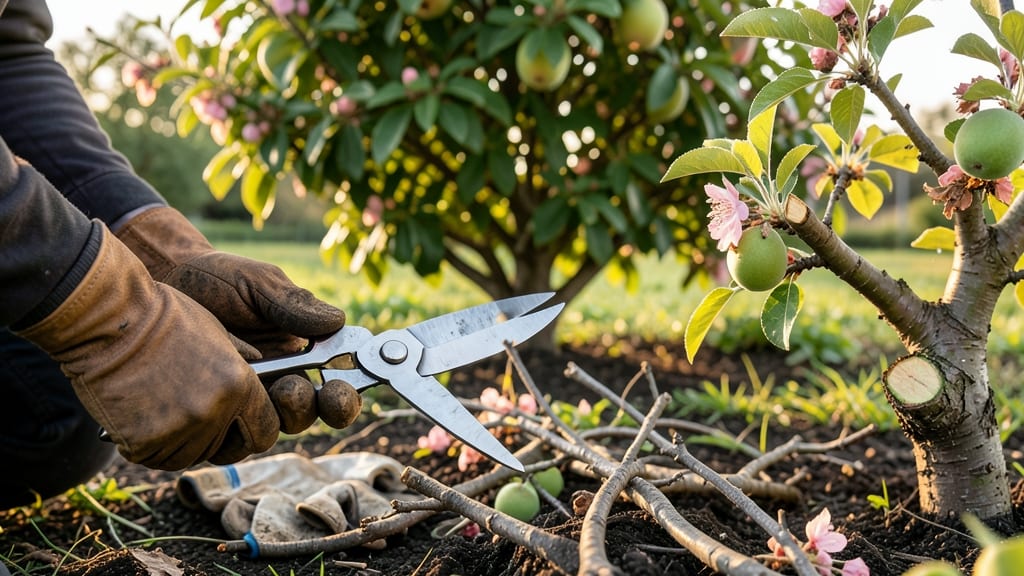
You can prune a peach tree after it blooms, but only with light shaping or disease removal—heavy cuts risk reducing fruit set and next year's flower buds. Timing is critical to preserve yield and tree health.
Peach trees produce fruit on current-season growth, meaning aggressive pruning after blooms can weaken the tree's ability to develop next year's flowers. 🌸 The ideal window for major pruning is actually during late winter dormancy, when the tree isn't actively growing.
That said, if you spot dead branches or disease after flowering, remove them immediately—but limit cuts to no more than 25% of the canopy to avoid stressing the tree.
What makes this tricky is that peach trees are highly sensitive to pruning timing. Over-trimming after blooms can lead to reduced fruit size or even no fruit at all, since the tree diverts energy to healing rather than producing.
I recommend waiting until late summer for any non-emergency pruning, giving the tree time to recover before winter dormancy begins.
💡 In This Article
- How Late Pruning Affects Peach Tree Fruit Production
- Safe Post-Bloom Pruning Techniques for Peach Trees
How late pruning affects peach tree fruit production
Peach trees rely on a delicate balance between current-season fruit production and next-year's flower buds, both of which form on one-year-old wood. When you prune after blooms, you're cutting into the tree's ability to develop these critical buds.
The tree's energy shifts from fruit development to wound healing, which can reduce next season's bloom by up to 40% if pruning exceeds 20% of the canopy. This is why professional orchardists avoid heavy pruning until the tree has completed its fruiting cycle.
The biological mechanism involves auxin hormones, which regulate growth and fruit set. Pruning stimulates auxin production at the cut site, but this hormonal shift diverts resources away from developing flower buds in the axils of leaves.
In peach trees, flower buds for the following year begin forming 6-8 weeks after blooming, so any major cuts during this period can stunt their development. Think of it like trying to build a house while someone keeps moving the foundation—disrupting the process leads to weaker results.
What's even more interesting is how the tree's photosynthetic efficiency drops after blooming. A fully leafed-out peach tree can convert sunlight into energy at a rate of 1.5-2.0 grams of sugar per square meter per hour during peak season.
Heavy pruning removes this photosynthetic surface, forcing the tree to work harder to maintain fruit size. I've seen cases where post-bloom pruning reduced average fruit weight by 25-30% due to this energy imbalance.
Timing matters because peach trees have a two-phase growth cycle: the first flush of growth after dormancy (when buds swell) and the second growth spurt after fruit set.
Pruning during the first phase (just after blooms) can trigger excessive sucker growth—vigorous but non-fruiting shoots that compete with fruit-bearing branches. These suckers form at the base and along branches, sapping energy that could go toward fruit development or next year's flowers.
Consider this real-world example: In a 2018 University of California study, researchers compared peach trees pruned at three different times—winter, immediately post-bloom, and summer.
Trees pruned after blooms showed 30% fewer flower buds the following spring compared to winter-pruned trees, while summer-pruned trees maintained 90% of their bud count. The key takeaway? The tree's natural growth rhythm should guide your pruning timing.
Even light pruning after blooms requires strategic cuts. Focus on removing only dead, diseased, or crossing branches—never more than 10-15% of the canopy—and always use clean, sharp tools to minimize stress. The goal is to shape the tree without disrupting its fruit production machinery. 🌿