
Plants
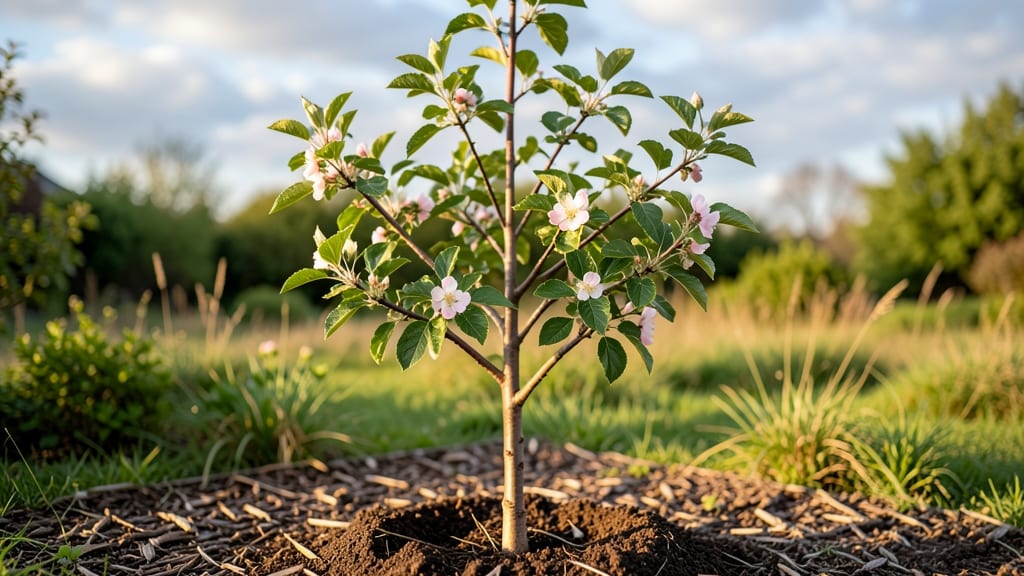
A young apple tree looks like a slender, upright sapling with smooth, light gray bark and small, oval-shaped leaves that are dark green and slightly serrated. Its branches grow in a vase-like shape, and it develops tiny white or pink blossoms in early spring before fruiting years later.
A young apple tree's most distinctive feature is its dark green, serrated leaves that grow in alternating patterns along the branches. 🌿 These leaves are typically 1-3 inches long and have a slightly waxy texture, which helps distinguish them from similar trees like crabapple (which often have more rounded leaves) or pear (which tend to be broader).
The smooth, light gray bark is another key identifier—it contrasts sharply with the rougher bark of older apple trees, making young specimens easy to spot in orchards or landscapes.
The vase-shaped branching pattern is a hallmark of healthy apple tree growth, especially in the first few years. This structure allows for optimal sunlight exposure and air circulation, which are critical during the tree's formative stages.
In early spring, watch for clusters of 5-petaled white or pink blossoms—these signal the tree's transition toward eventual fruit production, though it may take 3-5 years before you see actual apples.
Understanding these visual cues helps gardeners and orchard managers monitor growth and intervene early if they notice signs of disease or pest stress.
💡 In This Article
- Identifying Young Apple Tree Leaves and Bark Features
- Growth Stages of a Young Apple Tree: What to Expect Year by Year
Identifying young apple tree leaves and bark features
The leaves of a young apple tree are its most reliable identifier, featuring a distinctive oval shape with serrated edges that resemble tiny saw teeth under close inspection.
These leaves typically measure between 1-3 inches long and 0.5-1.5 inches wide, with a vibrant dark green color on top and lighter green undersides.
The leaf veins form a delicate network that's slightly more pronounced than in crabapple varieties, which often have smoother leaf margins and less pronounced serrations. 🌿 The waxy coating on the leaves helps repel pests and retain moisture, a key adaptation for young trees still establishing their root systems.
The bark of young apple trees is another standout feature, characterized by its smooth, light gray texture that often has subtle horizontal lenticels (tiny raised pores) running along its surface.
Unlike the rough, furrowed bark of mature apple trees, young bark remains silky to the touch and can even develop a faint sheen when wet.
This smoothness is crucial for identifying young specimens, as it distinguishes them from similar-looking trees like pear trees, which develop a more textured bark earlier in their growth cycle.
The vase-like branching pattern emerges during the first two years, with the central leader (main upward-growing branch) clearly dominant over side branches.
What makes these visual cues particularly useful is how they change as the tree matures. In their first year, young apple trees may produce only a few leaves clustered near the top, while by year three, you'll typically see 10-15 leaves per branch arranged in alternating patterns.
The blossoms that appear in early spring are another key feature—they grow in clusters of 5-7 flowers per stem, with each blossom containing 5 white or pink petals arranged in a perfect radial pattern.
This flower structure helps pollinators locate the tree's nectar efficiently, setting the stage for future fruit production.
For those trying to distinguish young apple trees from similar species, focus on these three key differences: leaf serration sharpness, bark smoothness, and flower cluster size.
Crabapple trees, for example, often have more rounded leaves and smaller flower clusters (typically 3-5 flowers per stem), while pear trees develop broader leaves with more pronounced midribs.
The vase-shaped growth habit is also more pronounced in apple trees than in their relatives, creating that signature upright silhouette that gardeners recognize immediately. 🌱
Understanding these botanical details isn't just academic—it helps you monitor your tree's health. For instance, if you notice leaves developing yellow edges or curling, it could signal early signs of apple scab or aphid infestation.
The smooth bark also makes young trees more vulnerable to sunscald, where sudden temperature fluctuations can damage the bark's surface. By recognizing these features early, you can take preventive measures like applying protective coatings or choosing optimal planting locations that provide afternoon shade during hot months.
One fascinating aspect of young apple tree leaves is their phototropic response—they'll naturally grow toward light sources, which is why you often see them leaning toward windows or breaking through dense foliage. This growth pattern continues until the tree establishes a strong root system, typically by its third year.
The serrated edges aren't just for show either; they help increase the leaf's surface area for photosynthesis while reducing water loss through transpiration. This dual functionality makes apple trees particularly efficient at converting sunlight into energy during their critical growth years. 💫