
Propagation
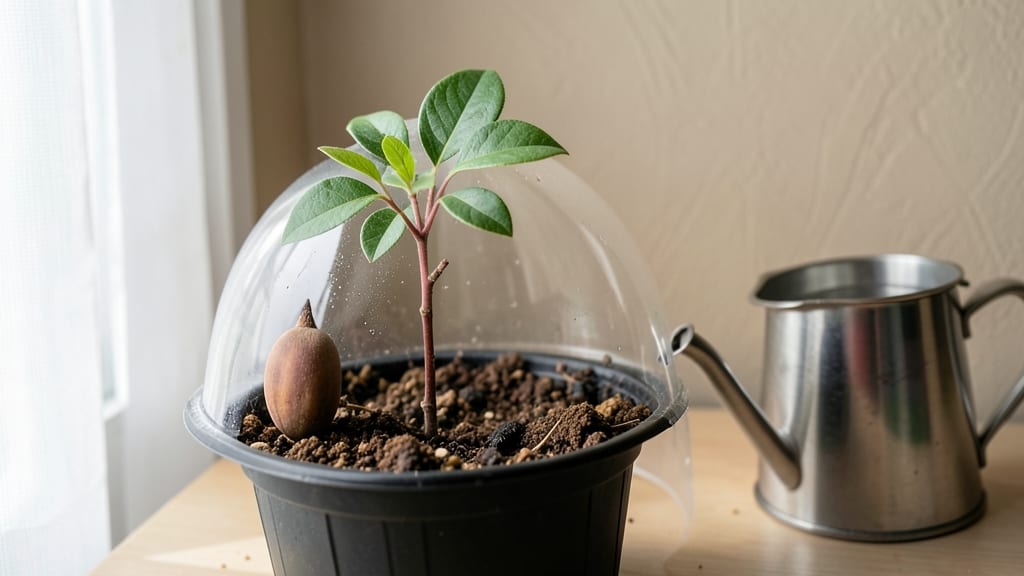
You can grow a persimmon tree from seed, but the process yields unpredictable results—seedlings often take 5–10 years to fruit and produce less flavorful, seedy varieties compared to grafted trees. Patience and potential grafting later may be necessary for reliable harvests.
Starting a persimmon tree from seed is like playing genetic roulette—you might get a beautiful tree, but the fruit could be disappointing. 🌱 The seeds require 60–90 days of cold stratification (mimicking winter) before they'll even sprout, and even then, the resulting tree may lack the disease resistance or sweetness of its parent.
Many gardeners who try this route end up grafting a more reliable cultivar onto their seedling later, turning a gamble into a strategic investment.
Seed-grown persimmons also tend to be non-astringent varieties (like 'Fuyu'), while grafted trees often produce the sweeter, astringent types ('Hachiya') that many chefs prefer. If you're patient and willing to wait, it's a rewarding experiment—but don't expect the same quality as nursery-bought trees.
💡 In This Article
- How Persimmon Seed Germination Works and Challenges
- Grafting vs. Seed-Grown Persimmon Trees: Key Differences
How persimmon seed germination works and challenges
Persimmon seeds need a process called stratification to break their natural dormancy—a survival mechanism that ensures they only sprout after winter's cold. The seeds contain a hard outer shell and an inner embryo that requires 60–90 days of cold, moist conditions (around 34–40°F) to trigger germination.
This mimics the tree's natural lifecycle, where seeds dropped in late autumn wouldn't sprout until spring. Without this cold treatment, seeds may remain dormant for months or never germinate at all.
The germination process itself is fascinating: once stratified, seeds absorb water and swell, cracking their shells as roots emerge first, followed by the shoot. This can take 2–4 weeks under ideal conditions (warmth, humidity, and light).
However, the resulting seedlings often exhibit heterozygosity—meaning their traits can vary wildly from the parent tree.
For example, a seed from a sweet 'Fuyu' persimmon might produce a tree with bitter fruit or take 5–10 years to fruit, while grafted trees from the same variety mature in 3–5 years.
Here's why this matters: persimmons are polyembryonic in some varieties, meaning a single seed can contain multiple embryos that may develop into genetically distinct seedlings.
This genetic diversity explains why seed-grown trees often have inconsistent fruit quality—some may produce small, seedy fruit, while others yield larger but bland varieties. 🌱 The unpredictability stems from the tree's natural cross-pollination habits, where seeds inherit traits from multiple parent trees.
Another challenge is the astringency trait, which determines whether the fruit is sweet when firm ('Fuyu' type) or must soften to become edible ('Hachiya' type). Seedlings rarely inherit this trait predictably, meaning you might end up with a tree that produces inedible fruit until it's fully ripe.
This is why many gardeners who start with seeds later graft in a known cultivar, like 'Izu' or 'McDaniel,' to ensure reliable harvests.
Consider the environmental factors too: persimmon seeds thrive in USDA zones 7–10, where they experience cold winters followed by warm summers. Without these conditions, stratification may fail, or seedlings could grow weak and prone to disease.
Even with successful germination, seed-grown trees often have weaker root systems compared to grafted trees, making them more susceptible to drought or wind damage.
For those eager to try, start by extracting seeds from fully ripe fruit, cleaning them, and storing them in a mix of moist peat moss and sand in the fridge for 90 days.
Plant them in well-draining soil at a depth of 1 inch, keeping the soil consistently moist. Patience is key—seedlings may take 1–2 years just to reach 3–5 feet tall, with fruiting delayed even longer.