
Pruning
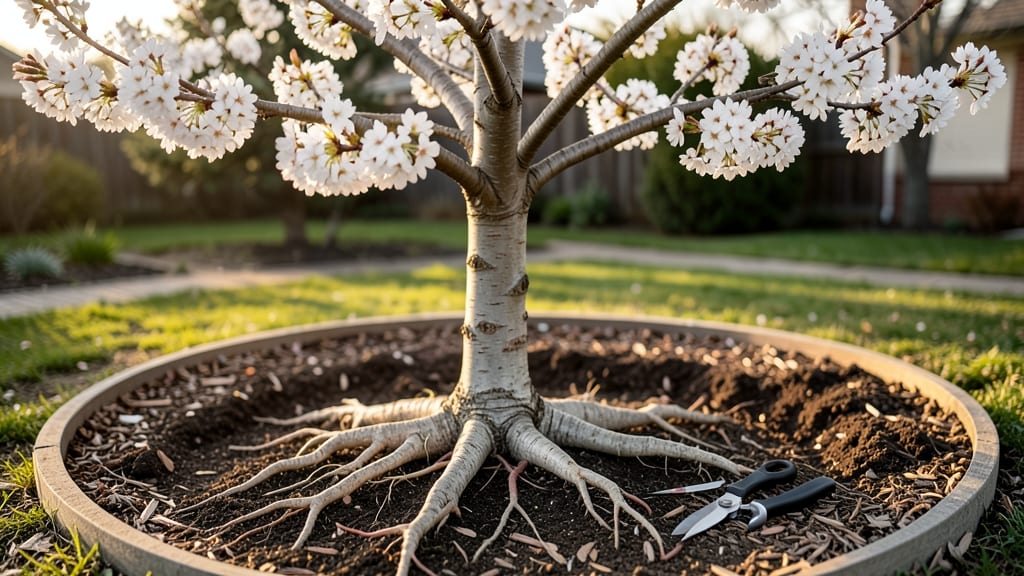
Flowering cherry tree roots spread 2-3 feet deep and extend 3-5 times the tree’s canopy width horizontally, requiring careful planting to prevent structural damage and root competition. Annual pruning of aggressive suckers helps maintain tree health and growth control.
Understanding how flowering cherry tree roots behave is key to their long-term health.
These trees develop a strong taproot that anchors deep, while their lateral roots spread aggressively outward—often reaching beyond the tree’s dappled shade. 🌳 The root system thrives in well-drained soil, but clay or compacted ground can force roots upward, causing instability.
This is why planting in loose, aerated soil with organic matter is essential for proper nutrient absorption and growth.
When planting, give your cherry tree plenty of space—at least 15-20 feet from structures, sidewalks, or other trees. Their expansive roots can lift foundations or crack driveways if unchecked. Mulching around the base helps regulate soil temperature while preventing aggressive root growth near the trunk.
For maintenance, focus on pruning suckers in late winter to redirect energy toward the main canopy rather than unwanted growth.
💡 In This Article
- How Flowering Cherry Tree Roots Grow and Their Impact on Soil
- Planting and Maintenance Tips for Healthy Flowering Cherry Trees
How flowering cherry tree roots grow and their impact on soil
Flowering cherry trees develop a biphasic root system—a deep taproot that anchors 2-3 feet down and lateral roots that spread horizontally. The taproot dominates in the first 2-3 years, seeking moisture and nutrients, while lateral roots expand aggressively outward at a rate of 12-18 inches per year.
This creates a canopy-to-root ratio where the lateral spread often exceeds 3-5 times the tree’s mature height (typically 20-30 feet for standard varieties). 🌱 The roots thrive in loamy soil with 60-70% porosity, but clay or compacted ground forces them upward, increasing surface root density and structural risks.
The root system’s nutrient absorption works through mycorrhizal fungi—symbiotic relationships where fungi extend the root’s reach by 30-50% in exchange for sugars. In clay-heavy soil, this process slows due to poor aeration, causing roots to girdle (wrap around their own base) or compete aggressively with nearby plants.
The tree’s water uptake also becomes inefficient, leading to leaf scorch or premature flowering decline. Sandy soils, conversely, drain too quickly, forcing roots to spread even wider in search of moisture. This is why amending soil with compost (20-30% organic matter) improves both water retention and root expansion.
One critical issue is girdling roots, where lateral roots grow in a circular pattern around the trunk, restricting sap flow. These often form when the tree is planted too deeply or in compacted soil, causing roots to curve unnaturally.
Over time, this can strangle the tree by blocking nutrient transport. Another problem is root competition—when planted too close to sidewalks or foundations, roots can lift concrete (up to 1-2 inches annually) or crack driveways due to their expansive growth pattern. 🚧 The solution?
Plant at least 15-20 feet from structures and avoid heavy mulch near the trunk to discourage surface root development.
Soil type dramatically alters root behavior. In loam, roots grow 20-30% deeper and spread 10-15% more efficiently than in clay.
For example, a flowering cherry in clay soil may develop 50% more surface roots within 5 years, while the same tree in loam will allocate more energy to taproot growth. This is why soil tests (checking pH 6.0-7.0 and organic matter levels) are essential before planting.
Acidic or alkaline soils (pH <5.5 or >8.0) also reduce mycorrhizal activity, weakening the tree’s ability to absorb phosphorus and zinc—critical for bloom production.
Seasonal growth patterns matter too. Roots are most active in spring and fall, when soil temperatures hover between 50-70°F. During drought, lateral roots can shrink by 30% to conserve moisture, but they rebound quickly with irrigation.
This adaptability explains why flowering cherries thrive in USDA zones 5-8—their roots can adjust to temporary water stress better than many ornamental trees. However, prolonged drought forces roots to seek water aggressively, increasing the risk of sidewalk heaving or foundation shifts. 💧
To mitigate these risks, aerate the soil to a depth of 12 inches before planting and mulch lightly (2-3 inches) with wood chips. Avoid piling mulch against the trunk—this creates anaerobic conditions that rot roots. Instead, keep mulch 6 inches away from the base to encourage deeper root growth.
For established trees, deep watering (1-2 inches per week) in the root zone (out to the drip line) ensures the taproot stays hydrated, while surface watering can promote shallow, problematic roots.