
Light Requirements
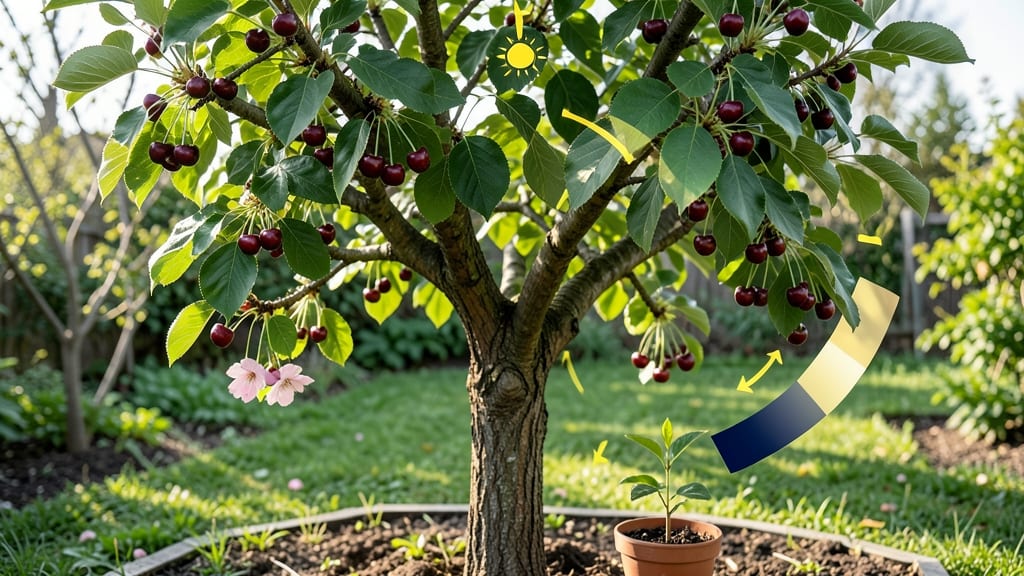
A cherry tree needs 6 to 8 hours of sunlight daily to thrive and produce fruit 🍒 — the difference between a lush canopy and a struggling sapling often comes down to how much light it gets.
Struggling to keep your cherry tree thriving? Sunlight is the #1 factor determining whether your tree bears fruit—or just leaves. Too little light means sparse blooms, poor fruit set, and weak growth, while too much can scorch the delicate leaves.
Even experienced gardeners sometimes get it wrong, especially in partial-shade spots or urban backyards.
Most cherry trees—whether sweet, tart, or ornamental—crave full sun, but a few varieties handle 4 to 6 hours just fine if you’re working with shade. The key is matching your tree’s needs to your yard’s conditions, whether that means pruning nearby branches or choosing a shade-tolerant cultivar.
Below, I’ll break down the exact light rules for each type, plus how to spot (and fix) sunlight mistakes before they stunt your harvest.
You’ll also discover which cherry varieties are the most forgiving when it comes to light, so you can still enjoy their beauty—and maybe even a few cherries—even if your space isn’t basking in peak sunshine. Let’s get started.


Daily sunlight requirements for cherry trees: minimum hours by variety
Cherry trees are sun-loving plants, but their exact light needs vary dramatically between sweet cherries (Prunus avium), tart cherries (Prunus cerasus), and ornamental varieties. While most need full sun for peak fruit production, some adapt to partial shade in microclimates.
Understanding these differences prevents stunted growth or poor harvests. Let’s break down the minimum sunlight hours each type requires, plus how to adjust for your garden’s conditions.
Sweet cherries like Bing or Rainier demand the most sunlight—8+ hours daily—to develop sweet, flavorful fruit. Tart cherries such as Montmorency or Meteor tolerate slightly less, thriving with 6-8 hours.
Ornamental varieties like Prunus serrulata (Japanese flowering cherry) often handle 4-6 hours but still bloom best in full sun. These distinctions matter: even 1-2 fewer hours can reduce fruit set by 30-50%.
Here’s a quick reference for cherry tree sunlight needs by variety, including microclimate adjustments for partial shade tolerance:
| Variety Type | Minimum Sunlight (Hours/Day) | Partial Shade Tolerance | Best For |
|---|---|---|---|
| Sweet Cherries (Prunus avium) | 8+ hours | 2-4 hours (marginal) | Fruit production, full-sun gardens |
| Tart Cherries (Prunus cerasus) | 6-8 hours | 4-6 hours (urban gardens) | Baking, preserves, cooler climates |
| Ornamental Cherries (e.g., Prunus serrulata) | 5-7 hours | 4 hours (spring blooms only) | Landscaping, spring color |
| Dwarf Varieties (e.g., 'Stella', 'Compact Stella') | 6-7 hours | 3-5 hours (containers) | Small spaces, patios |
For sweet cherries, even partial shade (like morning sun + afternoon shade) can cause smaller fruit and lower sugar content.
If your yard only offers 4-5 hours, opt for tart cherry varieties like 'Balaton' or 'North Star', which handle partial shade better while still producing tart, versatile fruit. These varieties also resist cracking in humid climates—a common issue for sun-starved sweet cherries.
Microclimates play a huge role. In hot, dry climates (e.g., USDA Zone 8+), afternoon shade helps prevent leaf scorch, but morning sun is non-negotiable for flowering. Conversely, in cooler zones (e.g., Zone 5-6), south-facing slopes extend sunlight by 1-2 hours naturally.
Use a sunlight tracker for a week to map your garden’s light patterns—this reveals hidden shade from buildings or trees that might limit your cherry’s growth.
Container-grown cherries (like dwarf 'Compact Stella') need at least 6 hours of direct sun, but their partial shade tolerance makes them ideal for patios or balconies. Place pots on wheelbarrows to rotate them toward the sun as it shifts seasonally.
Without this adjustment, you’ll see stunted branches and fewer blossoms—a clear sign of light deprivation. For potted trees, reflective surfaces (like white walls or gravel) can boost light exposure by up to 15%.
If your cherry tree is already planted and struggling, pruning can help redistribute energy. Remove overlapping branches to improve air circulation and light penetration to the inner canopy. Focus on thinning out rather than shearing, as dense foliage blocks sunlight from reaching lower branches.
This is especially critical for standard-sized trees, where inner leaves often receive only 20-30% of the sunlight hitting the outer canopy.
One common mistake is assuming all cherry trees need full sun year-round. In reality, young trees (under 3 years old) benefit from light afternoon shade in summer to reduce transplant shock. Use shade cloth (30-50% coverage) during peak heat (12–4 PM) if your region exceeds 90°F.
Over time, gradually increase sun exposure to acclimate the tree—this prevents sudden leaf burn when transitioning to full sun.
For urban gardeners, consider vertical training techniques like espalier to maximize sunlight on limited space. By growing cherries against a south-facing fence or trellis, you can increase light exposure by up to 40% compared to freestanding trees.
Pair this with dwarf varieties like 'Black Tartarian' to keep the tree manageable while still meeting its 6-7 hour sunlight requirement.
Signs your cherry tree isn’t getting enough sun (and how to fix it)
If your cherry tree looks more like a leafy green bush than a fruit-bearing giant, sunlight deprivation could be the culprit. Without enough light, your tree struggles to produce energy for blooms, fruit, and even basic growth.
I’ve seen sweet cherries with no fruit at all because they were planted under a neighbor’s oak tree—don’t let that happen to you!
Cherry trees are sun-worshippers, craving at least 6-8 hours of direct sunlight daily. When they don’t get it, their bodies scream for help in ways that are hard to miss.
The good news? Once you spot the signs, fixing the problem is often as simple as moving the tree or pruning nearby obstacles.
⚠️ How Much Sunlight Does a Cherry Tree Need?
Minimum: 6 hours of direct sunlight daily
Optimal: 8+ hours for fruit production
Maximum Tolerance: 4 hours (only for ornamental varieties in partial shade)
Urban Tip: South-facing yards get the most sun. North-facing spots may need reflective surfaces (like white walls) to boost light.
One of the first red flags is sparse or weak blooms. Cherry trees need sunlight to trigger flowering hormones. If you see just a handful of blooms instead of lush clusters, your tree is telling you it’s starving for light.
I once had a Stella cherry tree with only 3 blooms—moving it to a sunnier spot doubled its flowers the next year!
Poor fruit set is another dead giveaway. Even if your tree blooms, insufficient sunlight means those flowers won’t develop into cherries. You might see small, underdeveloped fruit that falls off early, or worse—no fruit at all. This is your tree’s way of saying, “I need more energy to feed my babies!”
Don’t overlook leaf color changes either. While some yellowing is normal, pale green or yellow leaves (especially on newer growth) signal light starvation. In extreme cases, you might see red or purple tinges—a sign the tree is stretching toward any available light.
If your tree looks like it’s reaching for the sky, it’s definitely not getting enough sun.
For urban gardeners or those with container-grown cherry trees, the fix is simple: move it! Place your tree near a south-facing window (if indoors) or relocate it to the sunniest spot in your yard.
If that’s not possible, consider dwarf varieties like ‘North Star’ or ‘Montmorency’, which tolerate slightly less light than standard trees.
If relocating isn’t an option, prune nearby shade sources like overgrown shrubs or tall buildings. Even thinning out dense branches can help. And remember: reflective surfaces (like white fences or mulch) can bounce extra light onto your tree.
With these fixes, you’ll see stronger growth, more blooms, and—most importantly—plump, juicy cherries in no time! 🍒