
Pruning
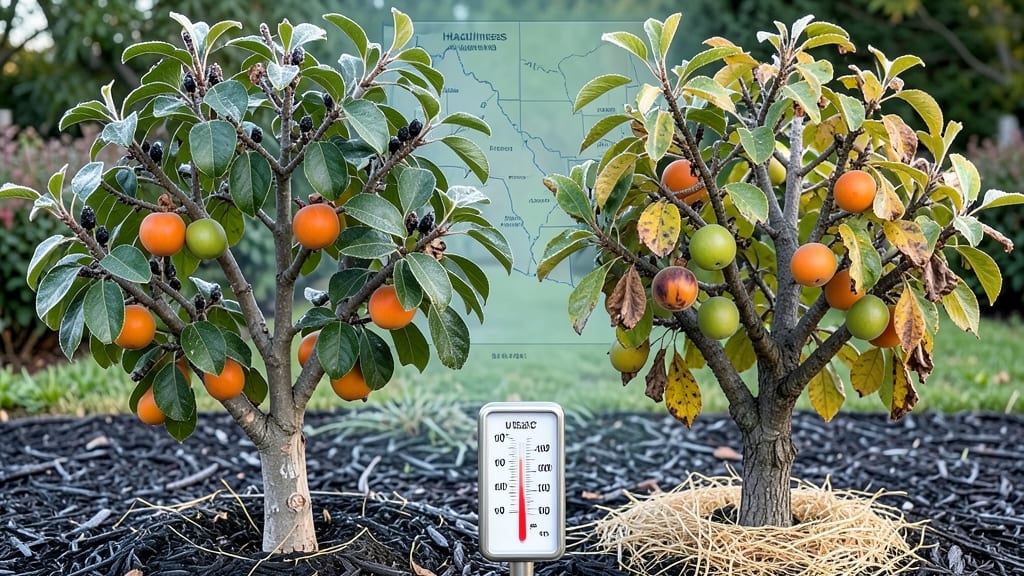
Understanding persimmon tree temperature tolerance reveals they can handle surprisingly cold winters, with mature trees enduring down to -15°F (-26°C) while younger trees require protection in areas colder than USDA Zone 5. Strategic winter care can push these limits even further.
Persimmon trees are cold-hardy champions, but their tolerance varies dramatically between juvenile and mature specimens. 🌳 The key difference lies in their development stage—young trees still establishing root systems struggle below 0°F (-18°C), while established trees develop thicker bark and deeper roots that act as natural insulation.
This biological adaptation explains why many gardeners in Zone 4 successfully grow persimmons with proper winter prep, including mulching and trunk wraps.
What truly sets persimmons apart is their ability to recover from cold damage. Even when branches suffer dieback, these trees often regrow vigorously from dormant buds. This resilience makes them excellent candidates for colder climates, provided you monitor moisture levels and avoid late-season fertilization that can weaken their cold resistance.
💡 In This Article
- Persimmon Tree Cold Hardiness by Variety
- Winter Care Tips for Persimmon Trees in Cold Climates
Persimmon tree cold hardiness by variety
American persimmons (Diospyros virginiana) lead the cold-hardiness race, naturally enduring temperatures down to -25°F (-32°C) once fully mature. Their native range spans from the southeastern U.S. to southern Ontario, where they've evolved to handle harsh winters.
The secret lies in their thick, corky bark that develops over years, acting like a thermal blanket.
Asian persimmons (Diospyros kaki), however, typically max out at -10°F (-23°C) unless cold-hardy cultivars like 'Fuyu' or 'Hachiya' are selected—these have been bred to push their limits closer to -15°F (-26°C).
The grafting process plays a surprising role in cold resistance. When Asian persimmons are grafted onto American persimmon rootstock, they inherit some of that hardiness, often surviving 5-10°F colder than they would on their own roots.
This is because the American root system develops deeper and more robust, while the Asian scion benefits from the improved nutrient and water uptake. 🌱 Young trees of both varieties, however, remain vulnerable—their bark is too thin and roots too shallow to withstand prolonged exposure below 0°F (-18°C), which is why nursery-grown specimens often come with winter care instructions.
Mature trees demonstrate another fascinating adaptation: their cambium layer (the growth tissue just under the bark) produces more protective compounds when exposed to gradual cold. This biological response explains why sudden freezes are more damaging than prolonged cold—there's no time for these protective measures to activate.
The contrast between juvenile and mature hardiness becomes especially clear when comparing a 3-year-old tree (which may dieback completely at -5°F (-21°C)) to a 15-year-old specimen that shrugs off -20°F (-29°C) with only minor branch dieback.
One variety stands out for its exceptional resilience: the American persimmon cultivar 'Meader' has been documented surviving -30°F (-34°C) in controlled tests, though this requires perfect growing conditions and winter protection.
The difference comes down to genetic selection—breeders have focused on trees that naturally produce thicker bark and more carbohydrate reserves in their roots, which act as antifreeze. This natural antifreeze isn't chemical but rather a concentration of sugars that lower the freezing point of water within the cells.
For gardeners in Zone 4, the choice often comes down to variety selection and site preparation. While American persimmons offer the best native cold tolerance, Asian varieties can succeed with proper winter care—especially when planted in microclimates where cold air pools drain away (like south-facing slopes).
The key measurement here is chill hours: most persimmons need between 500-1,000 hours below 45°F (7°C) annually to set fruit properly, making them well-suited to northern climates where winter lasts longer.
What most people don't realize is how persimmon trees recover from cold damage. Even when branches appear dead after winter, the tree often regrows from dormant buds at the base. This ability to regenerate from old wood is one of their most impressive survival traits.
The trade-off? It may take 2-3 years for the tree to fully recover its original size and fruit production after severe winter injury. 🌿