
Plants
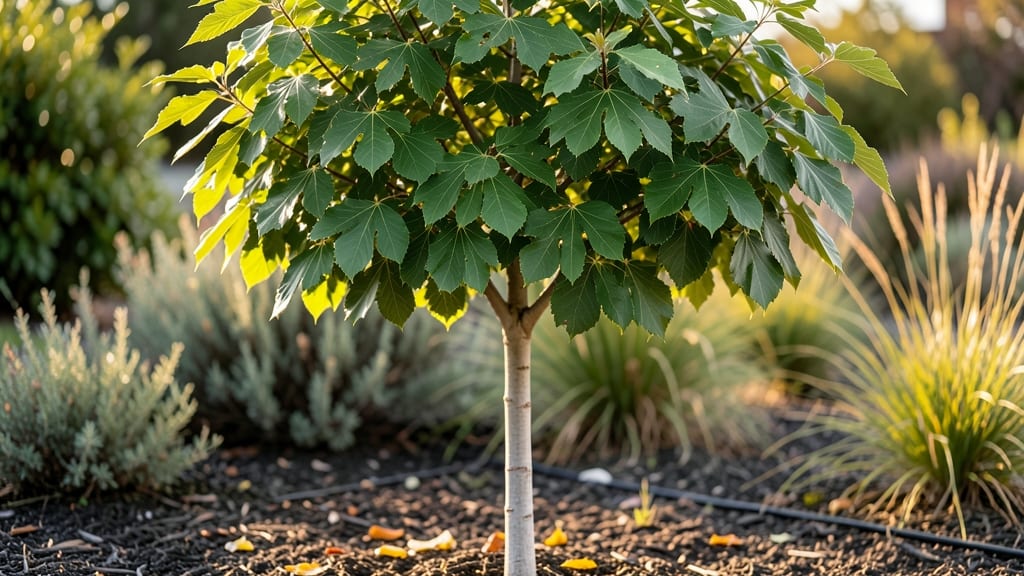
A young walnut tree looks like it has smooth, light gray bark and compound leaves with 5-9 leaflets, each 2-4 inches long, serrated edges, and a glossy green hue. Early growth is slow, with slender branches and a rounded canopy as it matures into its signature height and spread.
A young walnut tree's most distinctive feature is its compound leaves, which resemble a feather-like arrangement of leaflets. 🌿 Each leaflet has finely serrated edges and a slightly waxy texture that helps repel pests, while the undersides often show a lighter, almost silvery hue.
The bark starts off smooth and silvery-gray but begins developing shallow grooves as the tree ages, a key difference from other nut trees like hickory. These visual cues make young walnut trees easier to identify in their first few years of growth, even before they develop their signature nut clusters.
What many gardeners don't realize is how slow these trees grow initially. In their first 5 years, a young walnut tree typically gains only about 12-24 inches per year, with a spread that remains compact until it reaches maturity.
This slow start is why proper planting location matters—walnut trees need full sun and well-draining soil from the beginning to establish strong root systems. The rounded canopy shape in early stages helps distinguish them from other nut-bearing trees, which often develop more irregular branching patterns.
💡 In This Article
- Identifying Walnut Tree Leaf and Bark Characteristics
- Early Growth Stages and Walnut Seedling Care
Identifying walnut tree leaf and bark characteristics
The compound leaves of a young walnut tree are its most distinctive feature, with each leaf containing 5-9 leaflets arranged alternately along a central stem called the rachis.
Each leaflet typically measures 2-4 inches long and 1-2 inches wide, with finely serrated edges that create a delicate, almost lace-like appearance when viewed up close.
The upper surface has a glossy, deep green hue that reflects light beautifully, while the undersides often display a lighter, almost silvery-green tint due to fine hairs that help reduce water loss and deter pests.
The vein pattern on walnut leaflets is another key identifier—each leaflet features 8-12 pairs of secondary veins that branch out from the central midrib in a symmetrical pattern, creating a web-like network.
This venation contrasts sharply with hickory leaves, which have more pronounced, jagged lobes, or oak leaves, which typically have rounded lobes with bristle-tipped edges.
The leaflets also have a slightly waxy texture that makes them feel smooth to the touch, a protective adaptation against fungal infections that's common in many nut-producing trees.
The bark of a young walnut tree starts remarkably smooth, with a light gray to silvery hue that gives it a almost metallic sheen when sunlight hits it at certain angles.
This smooth texture remains consistent for the first 3-5 years of growth, making young walnut trees easy to distinguish from their relatives like black walnut trees, which develop rougher bark earlier.
As the tree matures past 5 years old, the bark begins developing shallow, diamond-shaped grooves that create a textured pattern—this transition marks a critical identification point for arborists and gardeners alike.
One fascinating detail about walnut leaves is their seasonal behavior—they often turn yellow or brown in late summer or early autumn, even before other trees, due to the tree's high nutrient demands as it prepares for nut production.
This early color change is a subtle but reliable indicator that you're dealing with a walnut species rather than other shade trees. The leaves also have a distinctive almond-like scent when crushed, which comes from the same compounds that give walnuts their characteristic aroma.
To further confirm you're looking at a walnut tree, examine the terminal bud at the end of each branch—walnut trees typically have a single, pointed bud that's slightly larger than the side buds, whereas hickory trees often have multiple buds clustered together.
This bud structure, combined with the leaf arrangement, creates a visual "signature" that makes young walnut trees identifiable even before they produce nuts.
What's particularly interesting is how these leaf characteristics serve the tree's survival needs. The compound leaf structure maximizes sunlight capture while minimizing water loss through transpiration, while the serrated edges help channel dew and rainwater toward the center of each leaflet.
This efficient design explains why walnut trees thrive in both dry climates and well-drained soils—their leaves are essentially engineered for water conservation from the very first growth stages.