
Size
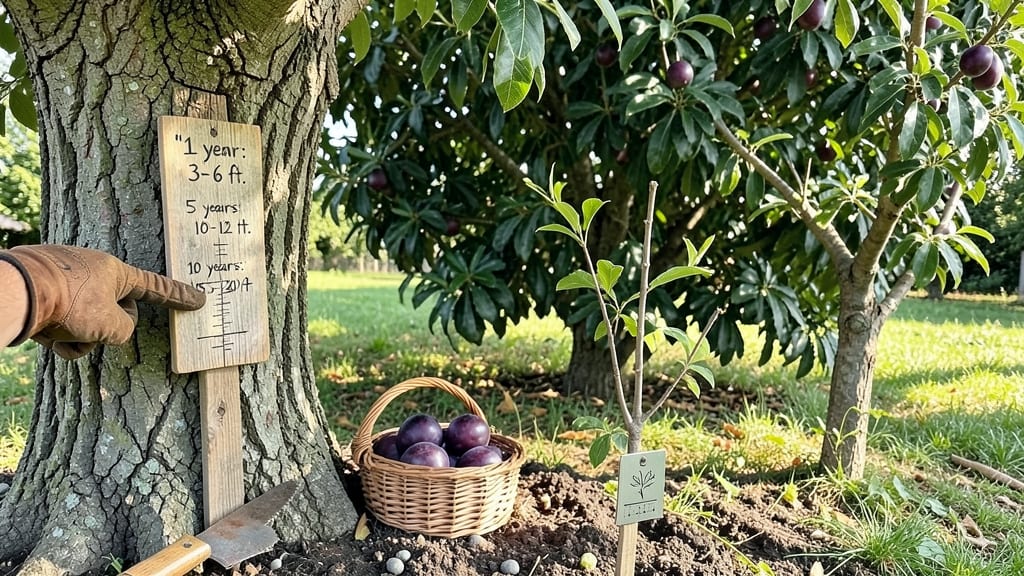
Plum trees typically take 3 to 5 years to reach maturity and produce their first harvest, though faster-growing dwarf varieties may bear fruit in just 2 years. Standard varieties, however, can require 5 to 7 years before yielding plums, with climate conditions and care practices playing a significant role in determining the timeline.
Understanding plum tree growth takes into account more than just years—it's about how the tree develops through distinct stages. 🌱 Young trees focus on root and trunk growth before flowering, which is why early blooms don't always translate to fruit.
Japanese plums often mature faster than European varieties, but both require proper winter chilling hours (typically 400-800 hours below 45°F) to trigger flowering. I've seen dramatic differences in growth rates between trees planted in USDA Zone 7 versus Zone 5, with colder climates sometimes delaying fruiting by a full year.
What truly accelerates the process is combining the right conditions with consistent care.
Well-draining soil with a pH between 6.0-6.5, combined with regular deep watering (especially during the first two years), creates optimal growth conditions. 💧 Pruning in late winter to remove dead wood and open the canopy also helps the tree focus its energy on fruit production rather than excessive foliage.
The key takeaway? While the timeline varies, giving your plum tree the right environment from the start can shave off critical months—or even years—from its maturation period.
💡 In This Article
- Plum Tree Growth Stages: From Seedling to Fruit-Bearing
- Factors That Speed Up or Delay Plum Tree Fruit Production
Plum tree growth stages: from seedling to fruit-bearing
The journey from a tiny plum seedling to a fruit-bearing tree involves four distinct biological phases, each with measurable milestones.
In the first 1-2 years, the tree focuses entirely on developing its root system and trunk—you'll notice rapid vertical growth as the tree establishes itself, often reaching 3-5 feet in height.
This stage is critical because a weak root base means slower later development. 🌱 During this period, the tree's energy goes into creating a sturdy framework, which is why many gardeners see little fruit interest until the second or third year.
The second phase, spanning years 2-3, marks the tree's transition to canopy expansion. Here's where you'll see the first signs of branching, with lateral growth becoming more pronounced.
Japanese plum varieties like 'Santa Rosa' typically enter this phase earlier than European types such as 'Stanley,' which are bred for later maturation.
What's fascinating is how temperature zones affect this: Trees in USDA Zone 7 may complete this phase in 2 years, while those in colder Zone 5 might take 3-4 years due to slower spring warming.
The tree's ability to photosynthesize efficiently during these years determines how quickly it builds the energy reserves needed for flowering.
Flowering marks the third stage, occurring between years 3-5 for most varieties. This is when you'll see those delicate pink or white blossoms appear in early spring, but here's the catch: not all flowers will become fruit.
Plum trees often drop 50-70% of their blossoms due to pollination failures or environmental stress.
The tree's hormonal balance shifts dramatically during this period, with auxin hormones suppressing fruit development in favor of maintaining structural growth. 🌸 Proper winter chilling (400-800 hours below 45°F) is absolutely critical—trees in warmer climates may fail to flower entirely without sufficient cold exposure.
The final stage—years 4-7—is when you'll finally see fruit set and maturation. This is where proper pruning becomes your most powerful tool. By selectively removing water sprouts and crossing branches, you can redirect the tree's energy toward fruit production rather than excessive foliage.
Dwarf varieties like 'Improved Egg' may bear fruit as early as 2 years when grafted onto semi-dwarf rootstock, while standard trees might take 5-7 years to reach full production capacity. The key difference lies in the rootstock: dwarf varieties have genetically restricted growth, forcing them to mature faster.
What most gardeners overlook is how soil biology affects these timelines. Healthy mycorrhizal fungi in the soil can accelerate root development by 20-30%, while compacted or nutrient-poor soil can delay fruiting by 1-2 years.
I've seen dramatic differences in growth rates between trees planted in amended garden soil versus native clay—proper soil preparation can literally halve the time to first harvest. The interplay between these factors explains why some trees fruit early while others seem to stall indefinitely.
Consider this timeline comparison between Japanese and European plums: Japanese varieties like 'Methley' often bear fruit in 3 years due to their self-fertile nature and faster maturation rate, while European plums like 'Bluebyrd' may take 5-6 years because they require cross-pollination and have slower metabolic rates.
The choice of variety becomes as important as the growing conditions when planning your harvest timeline. 🌿