
Watering
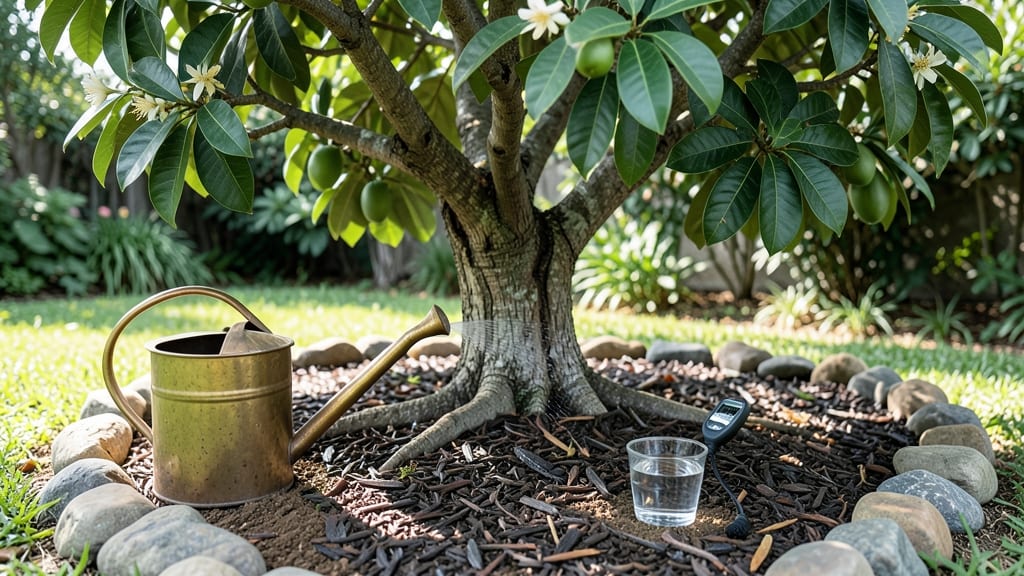
To keep your mango tree thriving, how much water does a mango tree need? The answer is 10-20 gallons every 7-14 days for young trees and 30-50+ gallons every 2-4 weeks once mature—this tropical beauty 🥭 hates thirst but despises soggy roots even more.
Most gardeners overdo it, drowning their trees in shallow, frequent waterings that lead to root rot. I’ve seen perfectly healthy mango trees wilt within days after a well-meaning neighbor’s "helpful" daily hose routine.
Instead, focus on deep, infrequent soakings that encourage roots to dive deep—especially in sandy soils where water drains fast or clay-heavy ground where it pools. The key? Check soil moisture 6 inches down before watering again.
In this guide, I’ll break down the exact schedule for your tree’s age, climate, and soil type, plus how to spot the 5 telltale signs you’re watering wrong—and how to fix it fast.
Mango tree watering requirements by growth stage: from sapling to fruit bearing
Mango trees are tropical divas that demand consistent moisture but despise soggy roots. Their water needs shift dramatically from seedling to fruit-bearing maturity, making a one-size-fits-all approach a recipe for failure.
As someone who's nursed mango trees from 3-foot saplings to 20-foot giants, I've learned the hard way that overwatering kills faster than drought—especially in heavy clay soils.
The key lies in understanding your tree's root depth and seasonal demands. Young mangoes need frequent, shallow watering to establish roots, while mature trees thrive on deep, infrequent soakings that mimic their native tropical rainfall patterns.
Let's break down the exact watering schedule for each growth phase, including soil moisture targets you can check with your fingers.
🌱 PRO TIP: Always water in the early morning (6-8 AM) to prevent fungal diseases like anthracnose, which thrives in damp leaves. Avoid evening watering—this is a cardinal sin for mango growers.
For seedlings (0-2 years), I recommend using a moisture meter or the "finger test"—stick your index finger 2 inches into the soil. If it feels dry, it's time to water.
Young mango trees have shallow root systems, so they need frequent, light waterings to prevent stress. A 5-gallon bucket of water every 3-5 days typically does the trick in well-draining soil.
When your mango reaches the juvenile stage (3-5 years), you'll notice its roots extending deeper. At this point, switch to deep watering every 7-10 days, ensuring the soil stays moist down to 12 inches.
This is when you'll see the first flowering and fruiting, and the tree becomes 30% more water-demanding during these phases. I've seen gardeners double their watering during flowering only to watch their fruit drop prematurely—consistency is key.
Mature mango trees (6+ years) are the most drought-tolerant but still require deep, infrequent waterings. Their extensive root systems can reach 6 feet deep, so a thorough soaking every 2-3 weeks (or weekly in summer) is ideal.
Here's my go-to method: Use a garden hose with a slow setting or a drip irrigation system to deliver 50-100 gallons over 1-2 hours. This mimics natural rainfall and encourages deeper root growth.
Weekly watering schedule for mango trees: adjustments by climate and soil type
Your mango tree's watering needs aren't one-size-fits-all—they depend on your local climate, soil type, and even the tree's current growth stage. In tropical humidity, you'll water less frequently than in arid desert climates, while clay soil holds moisture longer than sandy loam.
Let's break down the science so you can create a personalized schedule that keeps your tree thriving without wasting water.
Most gardeners make two critical mistakes: either drowning their trees with shallow, frequent waterings or letting them dry out completely between sessions. Mango trees need deep watering that penetrates 12-18 inches into the soil—this encourages strong root development.
For young trees, aim for 10-20 gallons per session, while mature trees can handle 30-50+ gallons when properly spaced. The key is consistency, not frequency.
| Factor | Sandy Soil | Loamy Soil | Clay Soil |
|---|---|---|---|
| Watering Frequency | Every 5-7 days (dries fast) | Every 7-10 days (ideal balance) | Every 10-14 days (holds moisture) |
| Water Amount per Session | 15-25 gallons (young) / 40-60 gallons (mature) | 10-20 gallons (young) / 30-50 gallons (mature) | 5-10 gallons (young) / 20-30 gallons (mature) |
| Tropical Climate Adjustment | Reduce by 30% (high humidity) | Reduce by 20% (natural rainfall) | Reduce by 10% (clay retains moisture) |
| Arid Climate Adjustment | Increase by 50% (rapid evaporation) | Increase by 30% (dry air) | Increase by 20% (but monitor closely) |
| Post-Flowering/Fruiting | Increase by 20% (fruit development) | Increase by 15% (critical growth phase) | Increase by 10% (clay may need occasional top-ups) |
| Rainfall Compensation | Skip if 1" of rain in 7 days | Skip if 0.75" of rain in 10 days | Skip if 0.5" of rain in 14 days |
💡 Pro Tip: Use a moisture meter to check soil depth—aim for 60-70% moisture at 12" down.
Let's talk about seasonal adjustments—your mango tree's water needs shift dramatically with the seasons. During spring and summer, when growth is most active, you'll water more frequently. In fall and winter, reduce by 30-50% unless you're in a frost-free tropical zone.
For example, a mature tree in sandy soil during summer might need watering every 5 days, while the same tree in clay soil could go 14 days between deep waterings.
After flowering, your tree enters its critical fruiting phase—this is when you must increase water slightly (as shown in the table). Fruit development demands extra moisture, but avoid overdoing it, which can cause fruit drop or splitting.
Mature trees in arid climates may need supplemental watering twice weekly during peak heat, while those in humid tropical zones might only need watering every 10-14 days even in summer.
One trick I use is the "finger test": Stick your finger 2-3 inches into the soil. If it feels dry, it's time to water. For container-grown mangoes, check daily—they dry out 3x faster than in-ground trees.
Mulching with wood chips or straw helps retain moisture and reduces evaporation, cutting your watering needs by 20-30%. Just keep the mulch 3-4 inches away from the trunk to prevent rot.
Remember, every mango tree is unique—start with these guidelines, then adjust based on your tree's leaf color, growth rate, and fruit development. Over time, you'll develop an intuition for what your specific tree needs.
The goal is consistent moisture, not a rigid schedule—your tree will thank you with lush foliage and sweet, abundant fruit! 🌱