
Lawn
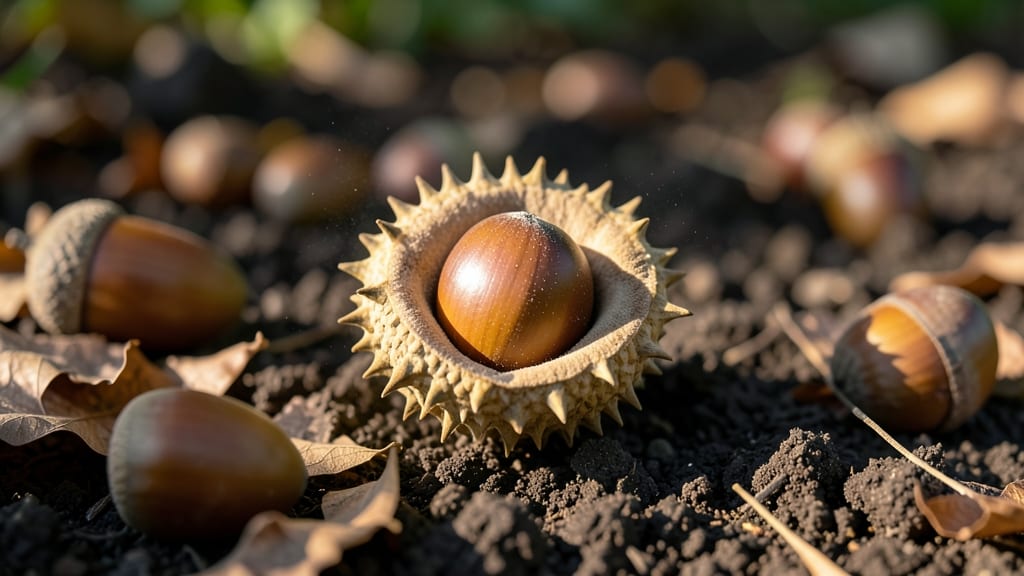
An oak tree seed, called an acorn, looks like a small, oval nut with a smooth or slightly rough brown husk and a pointed tip, often topped by a scaly, cup-like structure called the capule.
Oak tree seeds—acorns—vary in size from ½ inch to over 2 inches long, depending on the species.
The capule, which resembles a miniature pinecone, protects the seed while it matures, and its shape can help identify the oak type. 🌰 For example, white oak acorns have a smoother shell and a more rounded capule, while red oak acorns tend to be slightly more elongated with a more textured cap.
This variation isn't just visual—it reflects how each species adapts to its environment, from soil type to climate conditions.
What many people don't realize is that acorns aren't just seeds—they're a complete plant in miniature. Inside that tough shell lies the embryo, which contains the roots, stem, and leaves needed to grow into a full oak tree.
The capule's role is critical during this process, as it helps anchor the acorn to the ground and regulates moisture levels until germination occurs.
💡 In This Article
- Acorn Anatomy: Key Parts of an Oak Seed
- Identifying Oak Seeds: Species-Specific Acorn Traits
Acorn anatomy: key parts of an oak seed
The acorn's outer shell, called the nut, is actually a hardened fruit wall that protects the seed inside. This shell varies in texture from smooth (like white oak acorns) to deeply grooved or dimpled (common in red oak species).
The shell's thickness and composition—made primarily of cellulose and lignin—give it the strength to endure harsh conditions, including animal predation and weathering. 🌰 For instance, white oak shells are typically 1-2 millimeters thick, while red oak shells may be slightly thinner but more prone to cracking when dry.
At the base of the acorn sits the capule, a cup-like structure that resembles a miniature pinecone. This isn't just decorative—it plays a vital role in the acorn's development. The capule remains attached to the tree until the acorn matures, providing a moisture barrier that prevents premature drying.
Once detached, it helps anchor the acorn to the soil, ensuring proper orientation for germination. In white oaks, the capule often has shallow scales that overlap like shingles, while red oaks may feature more pronounced, spiky scales.
Inside the shell lies the embryo, which contains everything needed for a new oak tree: a tiny root system, a stem, and even the first leaves. The embryo is surrounded by the endosperm, a nutritious tissue that sustains the seedling during its early growth stages.
This internal structure explains why acorns are classified as "drupes"—a type of fruit where the seed is enclosed in a hard, stony layer. The embryo's position near the pointed tip of the acorn ensures it faces downward when the acorn falls, positioning the roots correctly for germination.
One fascinating detail is how the acorn's anatomy reflects its survival strategy. The pointed tip isn't just for aesthetics—it helps the acorn penetrate soil more easily when it falls. Meanwhile, the capule's shape varies by species to optimize seed dispersal.
For example, live oak acorns have a fleshy, almost meaty capule that attracts animals, aiding in their spread, while bur oak capules are more rigid and designed to cling to rough surfaces. This adaptation ensures the species can colonize new areas efficiently.
When examining an acorn, you'll notice the hilum, a small scar where the seed was attached to the ovary wall. This mark can help determine the acorn's age and whether it's viable. Fresh acorns have a bright, glossy appearance, while older ones develop a duller, more weathered look.
The hilum's position relative to the capule can also indicate the acorn's orientation when it was on the tree—this is crucial for proper germination when planting.