
Container Gardens
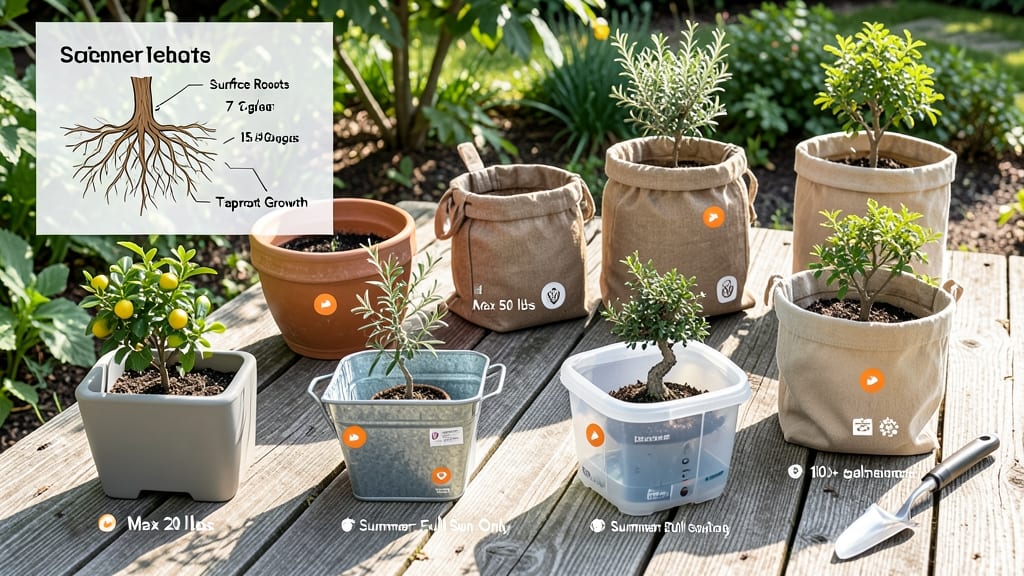
A tree container size chart helps you select the right pot dimensions by matching root ball size to mature tree height, using 5-gallon containers for saplings under 6 feet and 150+ gallon containers for mature trees over 20 feet. Always choose containers that are 2-3 times wider than the root ball to prevent stunted growth.
Understanding this chart starts with the root ball-to-container ratio, which directly impacts a tree's long-term health. 🌳 A 5-gallon pot might seem big for a small sapling, but it's actually the minimum for proper root development—any smaller risks circling roots that strangle growth.
For larger trees, the jump to 150+ gallons isn't just about volume; it accounts for the depth and stability needed to support mature canopies, especially in wind-prone areas. I've seen oak trees in 200-gallon containers thrive where smaller pots caused premature leaf drop.
This system also accounts for species-specific needs. Shallow-rooted trees like maples need wider, shallower containers, while deep-rooted pines require deeper pots to prevent root suffocation. The chart's width recommendations (2-3x root ball) create that critical air-pruning zone where roots develop outward instead of circling.
For example, a 3-foot root ball needs at least a 6-9 foot diameter container—something many gardeners overlook until they see stunted growth.
💡 In This Article
- How Tree Root Ball Size Determines Container Requirements
- Best Container Materials and Depths for Different Tree Types
How tree root ball size determines container requirements
Tree root ball size isn't just about volume—it's about creating the right environment for root development. The root ball diameter directly correlates to a tree's mature height because larger root systems support taller canopies.
For example, a 3-foot root ball typically corresponds to a tree that will reach 15-20 feet at maturity, while a 6-foot root ball suggests a 30-foot+ specimen.
This relationship explains why a 5-gallon container works for saplings under 6 feet—it provides just enough space for initial root expansion without overwhelming the young plant.
The critical factor here is the root-to-container ratio, specifically the width. Roots need at least 2-3 times the diameter of the root ball to develop properly.
This creates what arborists call an "air-pruning zone" where roots encounter the container walls and grow outward instead of circling. 🌱 For instance, a 12-inch root ball (common for small maples) requires a 24-36 inch diameter container.
Without this space, roots become compacted and form a dense, gnarled mass that strangles growth—a condition called "root binding" that often leads to leaf yellowing and stunted height.
Different tree species have unique needs based on their natural root structures.
Shallow-rooted trees like Japanese maples or crabapples need wide, shallow containers to spread their fibrous roots horizontally, while deep-rooted species such as white pines or red oaks require deeper pots (often 30-40% deeper than the root ball) to accommodate their taproots.
I've seen pine saplings in shallow containers develop "root suffocation," where the taproot can't penetrate downward, causing the tree to lean or fail to thrive despite adequate watering.
Container depth also plays a surprising role in long-term health. While width prevents root binding, depth affects stability and water retention. A 150-gallon container for a mature oak isn't just about volume—it provides the 18-24 inch depth needed to anchor the tree against wind and support its weight.
Shallow containers force trees to develop weak root structures, making them more susceptible to toppling in storms. This is why urban landscapes often use tree pits with 36-inch depths for large specimens—it mimics natural soil conditions while preventing root restriction.
One common mistake is assuming "bigger is always better." While oversized containers won't harm the tree, they create maintenance challenges. A 200-gallon pot for a 10-foot tree will dry out faster, requiring more frequent watering and heavier lifting.
The sweet spot is finding the smallest container that meets the 2-3x width rule while providing adequate depth. For example, a 4-foot root ball (like a young flowering cherry) thrives in a 75-gallon container with 20-inch depth—enough space for root expansion without excessive soil volume.
Understanding these ratios helps explain why some containerized trees grow poorly despite good care. The issue isn't always water or sunlight—it's often the container itself.
For instance, a 5-gallon pot might seem sufficient for a 3-foot sapling, but its 12-inch diameter only provides 1x the root ball size, forcing roots to circle. This explains why many nursery trees develop root-bound conditions before they even reach customers. The solution?
Always check the root ball diameter and multiply by 2-3 to determine minimum container size.
Here's a quick reference for common scenarios:
- Small saplings (under 6 ft): 5-15 gallon containers with 12-18 inch depth (ideal for maples, dogwoods)
- Medium trees (10-20 ft): 30-75 gallon containers with 18-24 inch depth (works for crape myrtles, small oaks)
- Large mature trees (20+ ft): 150+ gallon containers with 24-36 inch depth (required for pines, large oaks, elms)